


Imagine reaching toward a kitchen shelf and suddenly noticing discomfort in your shoulder. Simple activities like putting on a jacket, brushing your hair, or carrying a bag begin to feel more difficult. You want to improve your shoulder movement, but you’re worried that the wrong exercise might make things worse.
Learning about shoulder physical therapy exercises can help you understand how rehabilitation supports comfortable movement and muscle function. These exercises are designed to address specific problems involving shoulder mobility, strength, and stability. However, choosing suitable movements is essential for avoiding unnecessary discomfort.
Many people become frustrated when shoulder stiffness interferes with their daily routines. Some avoid moving their shoulders completely, while others attempt exercises that are too demanding for their current condition. Neither approach necessarily addresses the underlying problem.
This guide explains common shoulder rehabilitation exercises, their potential benefits, and important safety considerations. You’ll also discover how proper form, gradual movement, and professional guidance can support recovery. The goal is to help you understand your options and approach shoulder rehabilitation with greater confidence.
What Are Shoulder Physical Therapy Exercises?
Shoulder discomfort can make even familiar movements feel unfamiliar and challenging. You might struggle to lift your arm, reach behind your back, or complete routine household activities. Physical therapy exercises can help address certain movement difficulties when selected appropriately.
Shoulder physical therapy exercises are movements used to improve shoulder function, mobility, strength, and coordination. Physiotherapists select these exercises according to a person’s symptoms, medical history, and rehabilitation needs. Different shoulder conditions may require considerably different approaches.
These exercises generally fall into several categories:
- Mobility exercises: Support comfortable movement through available joint ranges.
- Flexibility exercises: Address stiffness in surrounding muscles and tissues.
- Strengthening exercises: Help muscles manage appropriate physical demands.
- Stability exercises: Improve coordination and control around the shoulder.
- Functional exercises: Support movements required for everyday activities.
The purpose of rehabilitation is not simply to increase how far your arm can move. It also involves helping your shoulder manage ordinary activities comfortably and effectively. A suitable program considers your individual condition rather than following a universal exercise routine.
Understanding How Your Shoulder Works
It can be difficult to understand shoulder rehabilitation without knowing how the joint functions. Unlike simpler joints, the shoulder depends on several bones, muscles, tendons, and connective tissues working together. This complex arrangement allows movement in many different directions.
The shoulder includes the upper arm bone, shoulder blade, and collarbone. The ball-shaped upper end of the arm bone fits into a relatively shallow socket in the shoulder blade. Surrounding muscles and connective tissues help maintain stability during movement.
The rotator cuff consists of four muscles and their tendons that contribute to shoulder movement and joint stability. These muscles work alongside the deltoid and muscles surrounding the shoulder blade. Their coordinated activity supports reaching, lifting, and rotating your arm.
When one part of this system becomes injured, irritated, or less functional, ordinary movements may become uncomfortable. Physical therapy can address certain movement and strength difficulties through appropriate rehabilitation. Understanding the underlying condition helps determine which exercises are suitable.
Why Do Shoulders Become Stiff or Painful?
Shoulder discomfort can develop even when you cannot remember experiencing a specific injury. Some people notice symptoms after prolonged desk work, while others experience discomfort following unfamiliar physical activities. Identifying possible contributing factors can help guide an appropriate response.
Prolonged Sitting and Limited Movement
Spending several hours working at a computer can leave your neck and shoulders feeling uncomfortable. Remaining in one position for extended periods reduces opportunities for varied movement. Some people experience temporary stiffness as a result.
Changing positions and taking comfortable movement breaks can help reduce prolonged inactivity. Adjusting your workstation may also make everyday tasks more comfortable. Persistent symptoms should be assessed rather than automatically attributed to sitting.
Repetitive Shoulder Movements
Activities involving repeated arm movements can sometimes place additional demands on shoulder tissues. Examples include certain household responsibilities, occupational tasks, and recreational activities. Symptoms may develop when physical demands exceed what the shoulder currently tolerates.
Adjusting activities and allowing sufficient recovery can help manage unnecessary strain. A physiotherapist can identify whether particular movements contribute to discomfort. Rehabilitation may involve gradually rebuilding tolerance for those activities.
Rotator Cuff Problems
Rotator cuff problems can affect how comfortably you lift and rotate your arm. These conditions may involve tendon irritation, injury, or other changes within the surrounding tissues. Symptoms can vary considerably depending on the underlying cause.
Physical therapy for rotator cuff problems may focus on improving movement, strength, and functional control. However, exercises suitable for one condition may be inappropriate for another. Professional assessment is particularly important after an injury or sudden loss of strength.
Shoulder Injuries
A fall, unexpected movement, or other injury can affect the shoulder joint and surrounding structures. Depending on the injury, you may experience discomfort, swelling, weakness, or restricted movement. Attempting unfamiliar exercises without an assessment could aggravate certain injuries.
Seek appropriate medical guidance when symptoms develop after an injury. A healthcare professional can determine whether rehabilitation, temporary protection, or further investigation is necessary. Recovery exercises should match the type and stage of injury.
Frozen Shoulder
Frozen shoulder is a condition that can cause shoulder pain and substantial movement restriction. Everyday tasks such as dressing or reaching overhead may become increasingly difficult. The condition can develop gradually and may require considerable time to improve.
Physical therapy may form part of an individualized treatment plan for frozen shoulder. The appropriate intensity of stretching and movement depends on the person’s symptoms and stage of recovery. Forceful stretching is not necessarily helpful and may increase discomfort.
8 Common Shoulder Physical Therapy Exercises
Finding suitable shoulder rehabilitation exercises can feel overwhelming when different sources recommend different movements. Rather than attempting every exercise, it is important to understand what each technique is intended to accomplish. Your healthcare professional can help determine which movements fit your particular needs.
The following exercises are educational examples commonly used in rehabilitation settings. They are not a complete treatment program or a substitute for an individualized assessment. If you have shoulder pain, an injury, instability, or recent surgery, obtain professional guidance before trying them.
1. Shoulder Pendulum Exercise
Moving your arm may feel difficult when your shoulder is particularly stiff or sensitive. The pendulum exercise uses gentle movement while allowing the arm to remain relatively relaxed. It is sometimes introduced during appropriate stages of shoulder rehabilitation.
How the exercise is performed:
- Stand beside a stable table or countertop.
- Support yourself with your unaffected arm.
- Lean forward slightly and allow the other arm to hang comfortably.
- Use gentle body movement to let the hanging arm sway.
- Keep the movement small and controlled.
- Return to an upright position when finished.
The hanging arm should remain relaxed rather than actively swinging with force. Avoid adding weights or increasing the size of the movement without professional advice. Stop if the exercise causes pain or unusual sensations.
2. Shoulder Blade Squeeze
Some shoulder rehabilitation programs address the muscles that support and move the shoulder blades. These muscles contribute to coordinated arm movement and upper-body function. A gentle shoulder blade squeeze is one exercise that may help improve awareness of this area.
How the exercise is performed:
- Sit or stand in a comfortable position.
- Allow your arms to rest naturally.
- Relax your neck and shoulders.
- Gently draw your shoulder blades toward each other.
- Release the position without sudden movement.
Avoid squeezing as hard as possible or forcing your shoulders downward. The movement should remain gentle and should not create additional neck tension. A physiotherapist can help adjust your technique if the exercise feels uncomfortable.
3. Supported Shoulder Table Slide
Lifting your arm without support may feel challenging when shoulder movement is restricted. A table slide allows a stable surface to support part of the arm’s weight. This can make certain shoulder movements more manageable during appropriate rehabilitation stages.
How the exercise is performed:
- Sit facing a stable table.
- Rest your hand and forearm on the surface.
- Place a small towel beneath your hand if needed.
- Gently slide your arm forward within an approved movement range.
- Bring your arm back toward the starting position.
Do not force your arm farther than your shoulder comfortably allows. Keep your upper body relaxed and follow any movement restrictions provided by your clinician. This exercise is not suitable for every shoulder injury or postoperative recovery stage.
4. Shoulder Wall Slide
Reaching upward can become frustrating when shoulder stiffness limits your available movement. A wall slide provides surface support while practicing controlled arm elevation. Physiotherapists may use this exercise when supported overhead movement is appropriate.
How the exercise is performed:
- Stand facing a smooth wall.
- Place your hands against the wall at a comfortable height.
- Gently slide your hands upward within your permitted range.
- Avoid forcing the movement at the highest point.
- Slowly return your hands to the starting position.
Do not treat reaching the highest possible position as the objective. Your comfortable movement range may change during rehabilitation. Stop if you notice sharp pain, instability, or increasing discomfort.
5. Cross-Body Shoulder Stretch
Stiffness around the back of the shoulder may affect certain reaching movements. A cross-body stretch is sometimes used to address flexibility in this area. However, it may not be appropriate for every painful shoulder condition.
How the exercise is performed:
- Sit or stand comfortably.
- Bring one arm gently across the front of your body.
- Support the upper arm with your opposite hand.
- Move only until you experience mild, comfortable tension.
- Release the position gradually.
Avoid pulling forcefully on the elbow or pressing the arm tightly against your chest. The stretch should not reproduce sharp pain or uncomfortable pressure inside the shoulder joint. Ask your physiotherapist whether this movement is suitable for your condition.
6. Isometric Shoulder Exercise
Some people find that moving through a large range is uncomfortable during early rehabilitation. Isometric exercises involve muscle activation without noticeable joint movement. They may provide an option for introducing controlled muscle activity when professionally recommended.
A physiotherapist may demonstrate an isometric exercise using a wall or another stable surface. The shoulder muscles generate gentle tension while the arm remains in an approved position. The direction and intensity of pressure depend on the muscles being addressed.
These exercises should not involve maximum effort or prolonged straining. Applying excessive pressure can increase demands on sensitive or healing tissues. Follow your clinician’s instructions regarding resistance, duration, and recovery.
7. Assisted Shoulder Rotation
Rotating your shoulder may feel restricted when surrounding tissues are stiff or sensitive. Assisted rotation exercises allow another arm or suitable equipment to provide controlled support. These techniques are sometimes included in individualized shoulder mobility programs.
A physiotherapist may use a lightweight stick to demonstrate an appropriate assisted rotation movement. The unaffected arm helps guide the movement while the affected shoulder remains within its permitted range. The technique can be adjusted according to the person’s symptoms and rehabilitation stage.
Assisted movement does not mean pushing the shoulder beyond its natural limits. Rotation restrictions are especially important following certain injuries and surgical procedures. Obtain specific professional instructions before using this exercise.
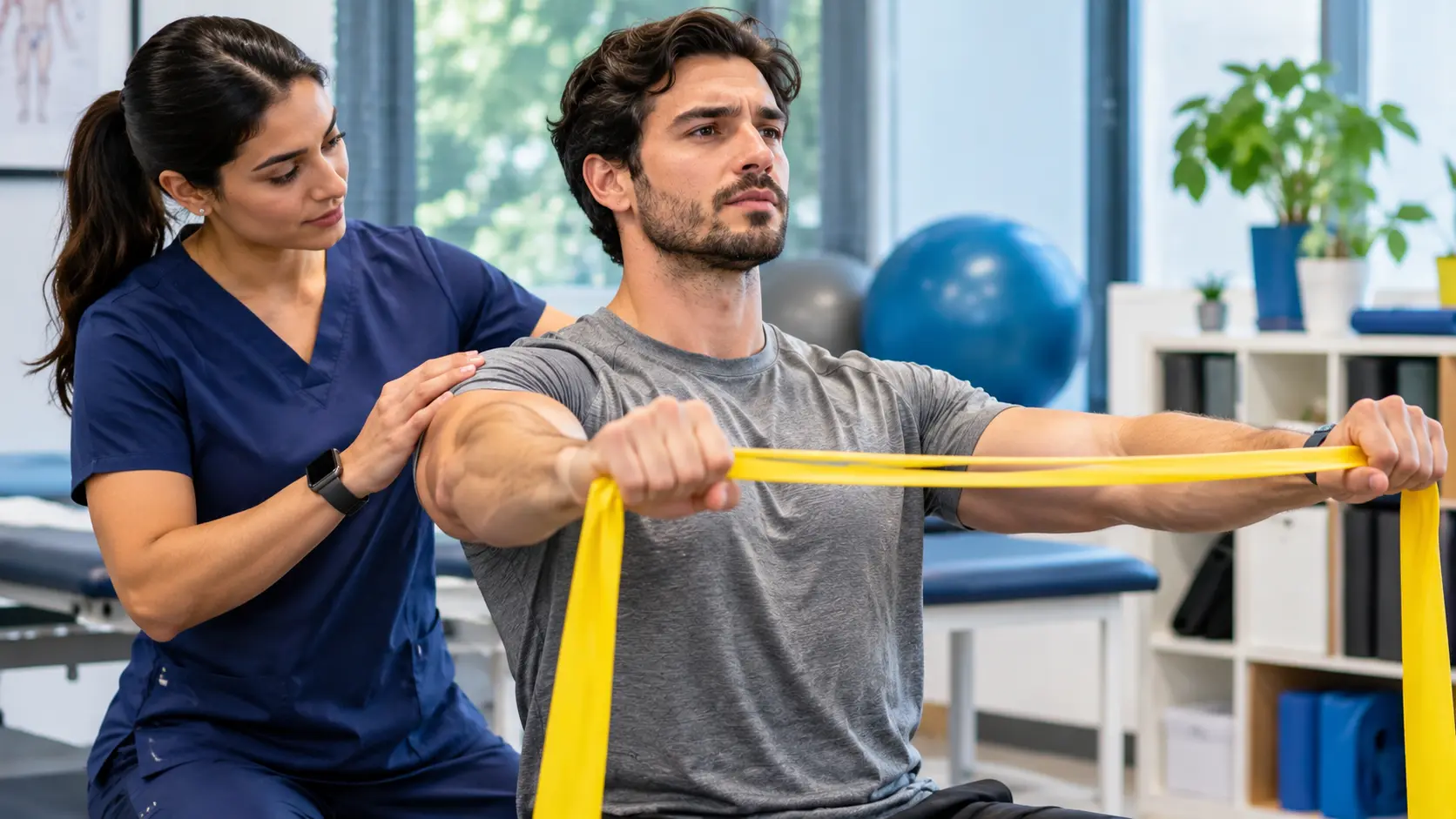
8. Resistance Band Shoulder Exercises
Rebuilding shoulder strength may become an important part of rehabilitation once the joint is ready for additional resistance. Resistance bands provide an adjustable way to introduce strengthening exercises. Physiotherapists may use them to target the rotator cuff and surrounding shoulder muscles.
Common rehabilitation movements include controlled inward rotation, outward rotation, and shoulder blade exercises. The appropriate band resistance and movement range depend on individual strength and recovery needs. Professional guidance helps ensure that the selected exercises match the underlying condition.
Using stronger resistance does not automatically produce better rehabilitation results. Excessive resistance or poor control can place unnecessary demands on the shoulder. Progression should be based on comfort, functional improvements, and clinical recommendations.
Which Shoulder Exercise Is Right for You?
Seeing several rehabilitation exercises may leave you unsure about where to begin. Each movement serves a different purpose, and some require more shoulder mobility than others. Choosing exercises according to your needs is more useful than following every available technique.
| Shoulder Exercise | Main Purpose | Important Consideration |
|---|---|---|
| Pendulum exercise | Gentle supported movement | Keep the arm relaxed |
| Shoulder blade squeeze | Muscle coordination | Avoid forceful squeezing |
| Table slide | Assisted shoulder mobility | Stay within an approved range |
| Wall slide | Controlled arm elevation | Avoid forcing overhead movement |
| Cross-body stretch | Posterior shoulder flexibility | Check suitability for your condition |
| Isometric exercise | Controlled muscle activation | Follow professional resistance guidance |
| Assisted rotation | Shoulder rotational mobility | Respect movement restrictions |
| Resistance band exercise | Muscle strengthening | Use clinician-approved resistance |
Someone recovering from surgery may require a completely different program from someone experiencing occasional stiffness. Even people with similar symptoms can have different underlying conditions. An individualized assessment helps prevent unsuitable exercise choices.
Benefits of Shoulder Physical Therapy Exercises
Shoulder discomfort can affect your confidence in performing everyday activities. You might begin avoiding certain movements because you are uncertain about how your shoulder will respond. Appropriate physical therapy can help address some of these difficulties over time.
Improved Shoulder Mobility
Restricted shoulder movement can make ordinary responsibilities more challenging. Activities such as reaching for objects, dressing, and washing your hair may require additional effort. Suitable mobility exercises can help improve available movement in certain shoulder conditions.
Rehabilitation focuses on gradual improvements rather than immediately restoring every possible joint position. The appropriate movement range depends on your symptoms and medical circumstances. Comfortable functional progress is more important than achieving a specific measurement.
Better Shoulder Strength
Muscle weakness can make carrying objects or maintaining arm positions more difficult. Shoulder strengthening exercises may help rebuild the ability of surrounding muscles to manage everyday demands. This can be particularly useful during appropriate stages of rehabilitation.
Strength development requires suitable resistance, recovery, and controlled progression. Starting with exercises that exceed your current abilities may create unnecessary discomfort. Your physiotherapist can adjust the program as your shoulder function improves.
Reduced Shoulder Discomfort
Persistent shoulder discomfort can interfere with work, sleep, and recreational activities. Physical therapy may help reduce symptoms associated with certain musculoskeletal shoulder conditions. However, results depend on the underlying cause and suitability of the treatment.
Exercises are often combined with activity adjustments, education, and other appropriate rehabilitation strategies. Improvement may occur gradually rather than after a single session. Persistent or worsening symptoms should receive further professional evaluation.
Improved Joint Stability
The shoulder’s wide movement range depends partly on the coordination of surrounding muscles. When muscle function is affected, certain activities may feel less controlled or comfortable. Appropriate rehabilitation can support the muscular systems involved in joint stability.
Stability exercises are selected according to individual movement requirements and medical circumstances. People experiencing shoulder dislocations or instability may require specialized programs. Generic strengthening exercises should not replace professional assessment in these situations.
Greater Confidence in Everyday Activities
Shoulder discomfort can make people hesitant to perform movements they previously completed without difficulty. This uncertainty may affect household responsibilities, work activities, and recreational interests. Rehabilitation can help individuals gradually rebuild confidence in suitable movements.
A physiotherapist may introduce activities that reflect the person’s actual daily needs. Progress can be measured through meaningful tasks rather than exercise performance alone. Feeling more comfortable during ordinary activities is an important rehabilitation outcome.
Shoulder Mobility vs. Strengthening Exercises
People sometimes assume that all shoulder exercises accomplish the same objective. However, improving how far a joint moves is different from improving how effectively muscles manage physical demands. Understanding this distinction helps explain why rehabilitation programs contain different exercise categories.
Mobility exercises focus primarily on comfortable joint movement and available range. Strengthening exercises aim to improve the capacity of muscles to generate and control force. Both may be valuable when introduced at appropriate stages.
| Feature | Shoulder Mobility Exercises | Shoulder Strengthening Exercises |
|---|---|---|
| Main purpose | Improve or maintain movement | Improve muscle function |
| Typical resistance | Minimal or supported | Individually adjusted |
| Common examples | Table slides and assisted movement | Isometrics and resistance bands |
| Primary focus | Comfortable range | Controlled muscle activity |
| Progression | Gradual movement changes | Appropriate resistance changes |
| Suitability | Depends on joint condition | Depends on tissue readiness |
Some people may initially benefit from supported mobility activities before introducing strengthening exercises. Others may use both approaches within the same rehabilitation program. The appropriate sequence should reflect the individual’s diagnosis and recovery needs.
How to Perform Shoulder Physical Therapy Exercises Safely
Even a familiar rehabilitation exercise can become uncomfortable when performed with excessive force or unsuitable technique. People sometimes focus on completing a movement without noticing how their bodies respond. Paying attention to form and comfort helps support safer rehabilitation.
Begin With Appropriate Preparation
Moving directly into demanding shoulder activities may be uncomfortable when your body has been resting. Gentle everyday movement may help prepare your muscles for approved rehabilitation exercises. Your physiotherapist can recommend suitable preparation based on your condition.
Preparation should not leave you feeling exhausted or increase existing symptoms. Avoid unfamiliar warm-up movements that conflict with medical restrictions. The purpose is to prepare comfortably for rehabilitation rather than complete an additional workout.
Maintain a Comfortable Body Position
Concentrating on your shoulder can sometimes lead to unnecessary tension in your neck or back. You might hold your breath or adopt an uncomfortable position without realizing it. These changes can make an exercise feel more demanding.
Choose a stable position that allows comfortable movement and natural breathing. Keep surrounding muscles relaxed whenever the exercise permits. Ask your physiotherapist to review your form if you find yourself struggling.
Use Slow and Controlled Movements
Moving quickly can make it difficult to recognize when your shoulder reaches an uncomfortable position. Sudden changes in direction may also introduce unnecessary physical demands. Controlled movement allows you to observe your response more carefully.
Follow the movement speed recommended by your rehabilitation professional. Avoid swinging your arm or relying on momentum to complete an exercise. Proper control is more important than completing movements quickly.
Respect Your Available Range of Motion
Watching someone demonstrate a shoulder exercise may create the impression that everyone should achieve the same position. However, movement ranges differ according to anatomy, symptoms, and recovery stages. Copying another person’s range may be inappropriate for your circumstances.
Stay within the movement limits established by your healthcare professional. Avoid forcing your arm into positions that produce pain or instability. Rehabilitation progress should reflect your individual functional needs.
Allow Sufficient Recovery
Doing additional exercises may seem helpful when you want your shoulder to improve quickly. However, muscles and other tissues need appropriate recovery between physical demands. Excessive activity can aggravate symptoms instead of supporting improvement.
Follow the exercise schedule recommended by your physiotherapist rather than continually increasing it. Discuss lingering discomfort or unusual fatigue before making changes to your routine. Recovery is an essential part of rehabilitation.
Common Shoulder Physical Therapy Mistakes to Avoid
People sometimes become discouraged when rehabilitation exercises fail to provide immediate results. This frustration may lead them to increase resistance, force movement, or introduce unsuitable exercises. Recognizing common mistakes can help you maintain a more appropriate approach.
Exercising Through Sharp Pain
Some people believe that painful exercises are necessary for successful rehabilitation. However, sharp or worsening pain may indicate that a movement is inappropriate or too demanding. Pain should not be treated as proof that rehabilitation is working.
Stop an exercise that produces sharp pain, unusual weakness, or instability. Discuss persistent discomfort with your physiotherapist before continuing the movement. Your rehabilitation program can be adjusted when necessary.
Using Too Much Resistance
Increasing resistance may feel like an obvious way to rebuild shoulder strength. However, healing or sensitive tissues may not tolerate sudden increases in physical demand. Excessive resistance can also interfere with movement quality.
Use only the resistance recommended for your current rehabilitation stage. Avoid progressing simply because an exercise appears easy for someone else. Your clinician can determine when additional resistance becomes appropriate.
Shrugging During Arm Movements
When shoulder movement feels difficult, surrounding muscles may become more active to compensate. Some people notice their shoulders rising toward their ears during reaching activities. This may change how a rehabilitation exercise is performed.
A physiotherapist can assess whether this movement pattern needs adjustment. Avoid forcing your shoulder blades into a fixed position without guidance. The goal is coordinated movement rather than maintaining an artificially rigid posture.
Following an Unrelated Rehabilitation Program
Online shoulder exercises are often presented as though they are suitable for everyone. However, shoulder pain can result from several conditions with different rehabilitation requirements. An exercise intended for one problem may aggravate another.
Use educational resources to understand possible treatment approaches rather than independently diagnosing your condition. Obtain an individualized program when symptoms are persistent or significant. This is especially important following surgery or a traumatic injury.
Expecting Immediate Results
Shoulder rehabilitation can feel frustrating when improvements develop more slowly than expected. Some conditions require extended recovery periods, while others respond more quickly to appropriate management. A fixed recovery deadline may create unrealistic expectations.
Focus on meaningful improvements in everyday function rather than comparing your recovery with another person’s experience. Discuss progress and concerns during follow-up appointments. Your rehabilitation professional can adjust treatment according to your response.
Can Shoulder Physical Therapy Exercises Be Done at Home?
Attending physical therapy appointments may not always fit conveniently into your daily schedule. Home-based exercises can provide a practical way to continue certain rehabilitation activities between appointments. However, knowing which movements to perform remains essential.
Physiotherapists frequently provide home exercise programs tailored to individual needs. These programs may include approved movements, specific instructions, and guidance about when to stop. Following the prescribed program helps maintain consistency between supervised appointments.
Before performing rehabilitation exercises at home, consider these precautions:
- Confirm that the exercises are appropriate for your condition.
- Understand the correct technique before practicing independently.
- Use stable surfaces and suitable equipment.
- Follow prescribed movement and resistance limits.
- Stop if new or worsening symptoms develop.
- Attend follow-up appointments when recommended.
Home rehabilitation should support professional treatment rather than replace it when assessment is necessary. If an exercise becomes uncomfortable or difficult to understand, ask your physiotherapist for clarification. Small adjustments may make the movement more suitable.
How Long Does Shoulder Physical Therapy Take to Work?
Waiting for shoulder movement to improve can feel frustrating when discomfort affects your daily life. Unfortunately, there is no universal recovery timeline that applies to every shoulder condition. Rehabilitation duration depends on several individual and medical factors.
Some people with minor movement difficulties may notice gradual improvements within several weeks. More complex injuries, frozen shoulder, and postoperative recovery can require substantially longer periods. Recovery may also involve periods when symptoms temporarily fluctuate.
Factors influencing shoulder rehabilitation include:
- The underlying cause of shoulder discomfort.
- The severity and duration of symptoms.
- Previous shoulder injuries or medical conditions.
- The appropriateness of the rehabilitation program.
- Individual response to treatment.
- Recovery requirements following surgery.
Instead of expecting improvement by a specific deadline, discuss realistic goals with your physiotherapist. Regular reviews help determine whether the current approach remains appropriate. Rehabilitation plans may need adjustments as your condition changes.
How to Recognize Progress During Shoulder Rehabilitation
When you experience shoulder discomfort regularly, small improvements can be difficult to notice. You might focus entirely on whether pain has disappeared while overlooking changes in everyday function. Looking at several aspects of recovery provides a more useful perspective.
Possible signs of rehabilitation progress include:
- Dressing becomes more comfortable.
- Reaching for everyday objects requires less effort.
- Ordinary shoulder movement feels easier.
- Approved exercises become more manageable.
- Sleep is less frequently interrupted by shoulder discomfort.
- Everyday responsibilities become easier to perform.
These improvements do not necessarily occur together or follow a predictable order. Some people experience better movement before noticing significant changes in discomfort. Others may find that daily activities improve while certain movements remain restricted.
Share these observations with your healthcare professional during rehabilitation appointments. They can assess whether your progress matches the expected response to treatment. Functional improvements can help guide appropriate changes to your program.
When Should You Avoid Shoulder Exercises?
Continuing rehabilitation exercises despite concerning symptoms can sometimes create additional problems. Although movement is beneficial in many situations, certain shoulder conditions require medical evaluation before exercise begins. Understanding these circumstances helps you make informed decisions.
Stop exercising and seek appropriate medical advice if you experience:
- Sudden or severe shoulder pain.
- Significant swelling or visible changes in shoulder shape.
- New numbness, tingling, or muscle weakness.
- Difficulty moving your arm after an injury.
- A shoulder that feels unstable or repeatedly slips out of position.
- Increasing discomfort that does not settle after stopping.
- Fever alongside a red, hot, or swollen shoulder.
Shoulder pain accompanied by chest pressure, breathing difficulties, or sudden sweating may require emergency medical attention. These symptoms can indicate a medical problem unrelated to the shoulder muscles. Contact emergency services rather than attempting rehabilitation exercises.
People recovering from shoulder surgery should follow their surgeon’s and physiotherapist’s specific instructions. Certain movements may be restricted while tissues heal. General shoulder exercise recommendations cannot replace an individualized postoperative rehabilitation plan.
Practical Tips for Supporting Shoulder Recovery
Improving shoulder function involves more than completing rehabilitation exercises. Everyday habits, activity demands, and recovery opportunities can also influence how comfortably your shoulder moves. Making sensible adjustments may support your overall rehabilitation experience.
Adjust Your Workspace
An uncomfortable workstation can make routine tasks more demanding for your shoulders and neck. Position frequently used items within comfortable reach and support your arms when practical. Take opportunities to change positions throughout the day.
Modify Difficult Daily Activities
Repeatedly performing activities that aggravate your symptoms may create unnecessary discomfort. Consider temporary adjustments to how you reach, carry objects, or complete household responsibilities. A physiotherapist can help identify suitable modifications without unnecessarily restricting movement.
Prioritize Rest and Sleep
Shoulder discomfort can sometimes make finding a comfortable sleeping position difficult. Supporting your arm with a pillow may help if the position feels suitable. Discuss persistent nighttime pain or sleep difficulties with a healthcare professional.
Maintain Balanced Nutrition and Hydration
Your muscles and surrounding tissues require adequate nutrition to support normal function and recovery. Regular, balanced meals and sufficient hydration contribute to general physical well-being. Restrictive eating or unnecessary dietary changes are not required for shoulder rehabilitation.
Communicate With Your Physiotherapist
Rehabilitation exercises may need adjustments as your shoulder symptoms and movement abilities change. Tell your physiotherapist about exercises that feel uncomfortable or activities that remain difficult. Clear communication helps make the treatment plan more relevant to your needs.
Frequently Asked Questions
What are the best physical therapy exercises for shoulder pain?
Common rehabilitation exercises include pendulum movements, table slides, and shoulder blade exercises. However, their suitability depends on the underlying cause of pain. A physiotherapist can recommend movements appropriate for your particular condition.
Can physical therapy exercises improve shoulder mobility?
Yes, appropriate physical therapy exercises may improve shoulder mobility in several musculoskeletal conditions. Supported movement and flexibility activities can form part of rehabilitation. The amount of improvement depends on individual circumstances and treatment suitability.
Should shoulder physical therapy exercises cause pain?
Rehabilitation exercises should not produce sharp, severe, or worsening pain. Some professionally supervised programs may allow manageable discomfort under specific guidance. Discuss unexpected symptoms with your physiotherapist rather than forcing yourself to continue.
Can I perform shoulder physical therapy exercises every day?
Exercise frequency depends on your condition, rehabilitation stage, and the movements prescribed. Some mobility exercises may be recommended more frequently than strengthening activities. Follow your physiotherapist’s schedule and allow appropriate recovery.
How long does shoulder rehabilitation usually take?
Shoulder rehabilitation may take several weeks or months depending on the underlying condition. Recovery after significant injuries or surgery can take longer. Regular professional assessments help determine realistic goals and appropriate treatment adjustments.
Conclusion
Shoulder physical therapy exercises can play an important role in improving mobility, supporting muscle function, and restoring comfortable everyday movement. Techniques such as pendulum exercises, supported table slides, and professionally guided strengthening provide different rehabilitation options. Choosing exercises that match your condition is essential for achieving meaningful improvements.
Remember that effective rehabilitation does not require forcing movements, tolerating sharp pain, or progressing as quickly as possible. Proper technique, appropriate recovery, and individualized professional guidance are important parts of the process. Gradual functional improvements are more valuable than completing demanding exercises.
Start by identifying which everyday shoulder movements currently feel difficult and discussing them with a qualified physiotherapist. Ask for a suitable rehabilitation program that addresses your symptoms and functional goals. The purpose of shoulder physical therapy is to help you return to everyday activities with greater comfort, confidence, and control.