


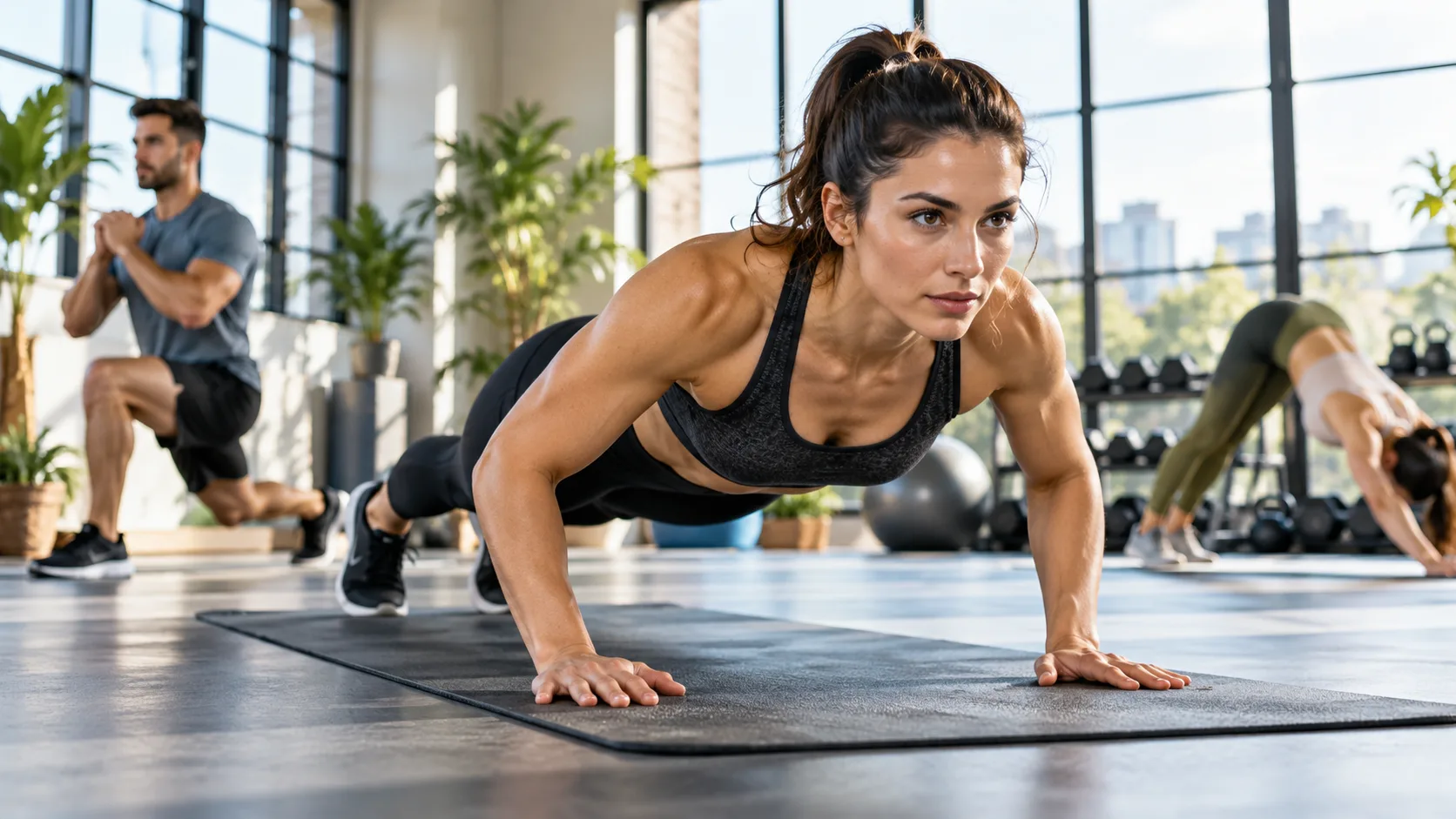
What Are Body Weight Exercises?
Body weight exercises use your own body as resistance instead of relying on dumbbells, machines, or barbells. Common examples include squats, push-ups, lunges, planks, glute bridges, and mountain climbers. These movements can train several muscle groups while also improving balance, coordination, mobility, and general physical fitness.
One of the biggest advantages of bodyweight training is its flexibility. You can perform many exercises at home, outdoors, in a hotel room, or in a small workout area. Because little or no equipment is needed, bodyweight workouts can fit different schedules, fitness levels, and training preferences.
Good technique remains important even when an exercise looks simple. Proper alignment, controlled movement, steady breathing, and an appropriate range of motion can make training more effective. Beginners should focus on learning movement patterns before trying faster repetitions or harder exercise variations.
Benefits of Body Weight Exercises
Bodyweight workouts can help build muscular strength and endurance while supporting everyday movement. Exercises such as squats and lunges train the lower body, while push-ups challenge the chest, shoulders, arms, and core. Regular training can also improve body awareness because you must control your own movement through each repetition.
Another benefit is convenience. A complete workout can be performed without a traditional gym, making bodyweight exercise useful for people with busy schedules or limited equipment. Short sessions can also be easier to fit into daily routines, although consistency matters more than trying to make every workout extremely long.
Bodyweight training can support cardiovascular fitness when exercises are arranged with shorter rest periods and a suitable pace. Movements such as mountain climbers, jumping jacks, and squat variations can raise your heart rate. The exact benefit depends on exercise selection, intensity, workout duration, fitness level, and how consistently you train.
Push-Up Form and Technique
The push-up is a classic upper-body bodyweight exercise that primarily challenges the chest, shoulders, triceps, and core. Start in a strong plank position with your hands slightly wider than shoulder-width. Keep your body relatively straight as you bend your elbows and lower your chest toward the floor.
Avoid allowing your hips to sag or rise excessively during the movement. Your head, shoulders, hips, and legs should remain controlled rather than moving as separate sections. Lower yourself at a comfortable speed, then press through your hands while maintaining stable positioning throughout the repetition.
Beginners can use an easier variation by placing their hands on a sturdy elevated surface. This reduces the resistance while allowing you to practice the same basic movement pattern. As your strength improves, gradually move toward floor push-ups before experimenting with narrower hand positions or other challenging variations.
Squat Form and Technique
Bodyweight squats are useful for developing lower-body strength and movement control. Stand with your feet around shoulder-width apart and keep your chest comfortably upright. Bend your knees and hips while lowering your body under control, allowing your knees to track naturally in line with your feet.
Your ideal squat depth depends on mobility, comfort, strength, and individual body structure. You do not need to force a very deep position if it causes discomfort or makes your technique unstable. Keep your feet grounded and maintain control as you drive through the floor to return to the starting position.
A common mistake is rushing through repetitions without maintaining stable movement. Another is allowing the knees to collapse inward during the upward phase. Practicing slow bodyweight squats with a comfortable range of motion can help improve coordination before moving toward harder variations.
Lunges for Lower-Body Strength
Lunges train the legs and hips while also challenging balance and coordination. Begin from a standing position and step one foot forward or backward, depending on the variation. Lower your body under control while keeping your torso stable, then push through the working leg to return to your starting stance.
Forward lunges, reverse lunges, and stationary split squats can all be useful. Reverse lunges may feel more manageable for some beginners because stepping backward can make balance easier to control. Whichever variation you choose, focus on smooth movement rather than trying to achieve a large range of motion immediately.
Keep the front foot stable and avoid allowing the knee to move unpredictably during the exercise. Your rear leg should assist with balance rather than carrying the entire movement. If balance is difficult, perform the exercise near a stable support and concentrate on controlled repetitions.
Plank Form for Core Strength
The plank is a popular bodyweight exercise for training the muscles that stabilize your trunk. Begin with your forearms or hands supporting your upper body while your legs extend behind you. Keep your body in a controlled position rather than allowing your lower back to sag or your hips to rise excessively.
Breathing normally is important because many people unintentionally hold their breath while performing planks. Tightening the abdominal muscles gently can help maintain a stable trunk without excessive tension. Start with a manageable hold and focus on maintaining good positioning from beginning to end.
Longer plank times are not automatically better. Once your form begins to deteriorate, extending the hold can reduce the quality of the exercise. Shorter, well-controlled sets can be more useful than forcing yourself to remain in position after your technique has noticeably declined.
Glute Bridges for Hip Strength
Glute bridges target the gluteal muscles and also involve the muscles around the hips and trunk. Lie on your back with your knees bent and feet positioned comfortably on the floor. Press through your feet and raise your hips while keeping your movement controlled rather than relying on momentum.
At the top of the movement, your hips should be elevated without excessive arching through the lower back. Pause briefly if comfortable, then lower your hips slowly. Thinking about driving through the feet and contracting the glutes can help you maintain better control during each repetition.
Glute bridges are often suitable for beginners because they require little space and relatively simple positioning. They can also be adjusted as strength improves by changing repetition tempo or progressing toward single-leg variations. Anyone experiencing pain should stop the movement and seek appropriate professional guidance.
Mountain Climbers and Dynamic Exercises
Mountain climbers combine core control with repeated leg movement and can raise your heart rate. Begin in a strong high-plank position with your hands beneath or near your shoulders. Bring one knee toward your torso, return it, and then switch sides while keeping your upper body controlled.
The exercise can be performed slowly when your priority is movement quality and core stability. Increasing the pace turns it into a more demanding conditioning exercise. Beginners should master the slower version first because rushing can lead to excessive hip movement and reduced control through the shoulders and trunk.
Other dynamic bodyweight movements include jumping jacks, high knees, and squat-to-reach patterns. These exercises can fit into warm-ups or conditioning sessions depending on your goals and fitness level. If jumping feels uncomfortable, lower-impact alternatives can maintain movement without placing the same demands on your joints.
Body Weight Exercises for Beginners
Beginners should start with movements that match their current strength, mobility, coordination, and training experience. A simple session might include bodyweight squats, incline push-ups, glute bridges, supported lunges, and a short plank. The goal is to learn controlled movement rather than immediately chase high repetition numbers.
Performing fewer repetitions with good technique can be more useful than completing many rushed repetitions. Rest when needed and pay attention to how your body responds during and after training. Gradually increasing training difficulty gives your muscles and movement skills time to adapt.
A beginner can train two or three times per week while leaving recovery time between demanding sessions. Daily light movement can still be useful, especially walking and gentle mobility work. As your fitness improves, you can adjust repetitions, sets, exercise variations, tempo, or rest periods to keep sessions appropriately challenging.
How to Build a Bodyweight Workout
A balanced bodyweight session can include lower-body, upper-body, core, and conditioning movements. For example, you might begin with squats, continue with incline push-ups, add reverse lunges, and finish with glute bridges and a plank. The exact structure should match your experience and fitness goals.
Performing exercises in circuits can make a session efficient, but continuous movement is not required. You can complete one exercise at a time with comfortable rest between sets. Beginners may benefit from longer recovery periods because maintaining good technique is more important than minimizing rest.
A warm-up can prepare your body for movement through light activity and gentle mobility exercises. After training, relaxed movement can help you transition back to normal activity. The overall session should feel challenging without becoming so exhausting that technique breaks down repeatedly.
How to Improve Bodyweight Exercise Progression
Progressive overload does not require adding weights. With bodyweight training, you can increase difficulty by performing more controlled repetitions, adding another set, slowing the lowering phase, reducing rest, or choosing a more challenging variation. Progress should remain gradual rather than changing several training variables at once.
For example, someone who can comfortably perform incline push-ups might eventually move toward floor push-ups. A standard squat can progress toward split squats or single-leg variations when strength and balance improve. The same principle applies to planks, bridges, lunges, and other movements.
Keep track of how exercises feel and whether your technique remains consistent. If a harder variation causes poor alignment or discomfort, return to an easier version and continue practicing. Progress is not always linear, so adjusting training based on recovery and performance can help maintain steady improvement.
Common Bodyweight Training Mistakes
One common mistake is sacrificing technique to complete more repetitions. Fast movements can sometimes be useful, but speed should not replace control when learning an exercise. Rushed repetitions may make it harder to maintain proper alignment and can reduce the intended training effect.
Another mistake is repeating the same exercises indefinitely without adjusting the challenge. Once an exercise becomes very easy, your body may need a different stimulus for continued strength development. Changing tempo, range of motion, exercise variation, sets, or rest periods can make training more appropriately demanding.
Skipping recovery can also interfere with progress. Muscles need time to recover after challenging sessions, particularly when the same movement patterns are trained frequently. Adequate sleep, balanced nutrition, hydration, and sensible scheduling all contribute to maintaining energy and exercise performance.
Bodyweight Training for Different Fitness Goals
Bodyweight exercise can be adapted for several fitness goals, although the training approach should change according to the desired outcome. For strength, controlled repetitions and progressively harder variations are useful. For muscular endurance, moderate repetitions with manageable rest periods may be more appropriate.
For general fitness, combining resistance movements with moderate conditioning can create a well-rounded session. Squats, push-ups, lunges, bridges, planks, and dynamic movements can train different physical qualities within one workout. The balance should reflect your experience, schedule, and ability to recover.
Bodyweight exercise can also support mobility and movement quality when exercises are performed through comfortable ranges of motion. It should not be treated as a single training method that works identically for everyone. Individual goals, fitness history, physical limitations, and preferences should guide exercise selection.
How Often Should You Do Bodyweight Exercises?
Training frequency depends on workout intensity, exercise selection, experience, and recovery. Many beginners can start with two or three structured bodyweight sessions each week. Leaving recovery time between demanding sessions can help reduce excessive fatigue while allowing muscles and movement skills to adapt.
More experienced exercisers may train more frequently by varying intensity and muscle groups. A demanding lower-body session does not necessarily need to be followed immediately by another equally demanding lower-body session. Alternating harder workouts with lighter movement can help maintain consistency without excessive fatigue.
Pay attention to persistent soreness, unusual weakness, declining performance, and discomfort that does not improve with rest. These signs may indicate that your current training load needs adjustment. A sustainable routine should fit your lifestyle rather than making every workout feel like an exhausting test.
Safety Tips for Bodyweight Workouts
Safety begins with choosing exercises that match your current ability. Learn the basic movement pattern before adding speed, complexity, or advanced variations. Use a stable surface and enough open space to move without obstacles, particularly when performing lunges, jumping movements, or dynamic exercises.
Pain should not be treated as a normal requirement for progress. Muscle fatigue and a challenging sensation can occur during training, but sharp, severe, or unusual pain deserves attention. If you have an injury, medical condition, or significant physical limitation, consult a qualified healthcare professional before beginning a demanding exercise program.
Warm up gradually and avoid suddenly performing difficult movements when your body is cold and unprepared. Keep your breathing controlled and stop when your technique repeatedly breaks down. Building fitness gradually is generally more sustainable than pushing beyond your current capacity during every workout.
Conclusion
Bodyweight exercises are a practical way to train strength, endurance, balance, coordination, and core stability with minimal equipment. Squats, push-ups, lunges, planks, glute bridges, and dynamic movements can be adjusted for different fitness levels and training goals.
Good form should remain the foundation of bodyweight training. Controlled repetitions, suitable exercise variations, gradual progression, adequate recovery, and sensible workout frequency can help you build a sustainable routine. You do not need complicated equipment to make bodyweight sessions challenging and productive.
The best routine is one you can perform consistently while maintaining safe technique and allowing enough recovery. Start with manageable movements, learn the fundamentals, and gradually increase the challenge as your strength and control improve. If discomfort or health concerns arise, seek guidance from an appropriately qualified professional.
FAQs
Are bodyweight exercises effective?
Yes, bodyweight exercises can improve strength, muscular endurance, balance, coordination, and general fitness. Their effectiveness depends on exercise selection, technique, training intensity, progression, recovery, and consistency.
Can bodyweight exercises build muscle?
They can support muscle development, particularly when exercises become progressively more challenging. Harder variations, controlled repetitions, adequate training volume, sufficient nutrition, and recovery can all influence muscle growth.
How often should beginners do bodyweight workouts?
Beginners can often start with two or three structured sessions per week. Recovery between demanding workouts allows the body to adapt while helping maintain good movement quality and consistent training.
Can bodyweight exercises help with weight management?
Bodyweight workouts can contribute to energy expenditure and muscle development, while regular physical activity supports overall fitness. Nutrition, daily movement, sleep, and individual energy needs also influence changes in body weight.
What is the best bodyweight exercise for beginners?
There is no single best movement for everyone. Squats, incline push-ups, glute bridges, supported lunges, and short planks are useful starting points because their difficulty can be adjusted to suit different abilities.